 TwinLadder
Pipeline collapse
The juniors who would have become your seniors are no longer hired, or no longer formed.
Owner: CHRO. Read by: the intake curve, against a floor.
TwinLadder is an app you subscribe to. It keeps your judgment register, runs the checks from the book, and gives your board a verified reading every quarter.
Runs in your browser. Nothing to install.
Free. The ten-question ladder from Judgment Capital, chapter 12. Your result shows on screen. See the app
Built on the book’s six modes (chapter 10) and its working methods (Appendix A).
Ladder score 13 of 20 · no zeros · next rung needs questions 3–5 at 2
| Mode | Owner | Reading this quarter | Threshold | Tier |
|---|---|---|---|---|
| Pipeline collapse | CHRO | Junior intake 4, down from 9 | Floor 6 | Concern |
| Competence drift | CRO | Override rate 2.1%; blind re-judgment agrees 91% | Re-judge 1 in 8 | Watch |
| Inquiry groupthink | CRO | Divergence method run on 3 of 5 board decisions | Every consequential decision | Watch |
| Detection blindness | CRO · CHRO | Claims desk caught 31 of 40 planted cases (78%) | 85%, set by the board | Concern |
| Authorship erosion | CRO | Tools-down rebuild: 6 of 10 completed unaided | Yearly, last Nov 2026 | Watch |
| Agency erosion | CRO | 0 overrides exercised; halt points named in 2 of 7 flows | A tested halt point in every flow | Watch |
AI will lift your productivity. The judgment that checks it is formed in the ordinary work the AI now does first. People learn judgment by doing the work: the first draft, the reconciliation, the first-pass check.
When the machine does that work, the output improves and the practice stops. The first rung of the ladder is no longer there.
Productivity of support agents with an AI assistant, on average. For novices, +34%.
Brynjolfsson, Li & Raymond, “Generative AI at Work”, NBER Working Paper 31161; Quarterly Journal of Economics, 2025.Experienced endoscopists’ unaided detection rate after routine AI assistance, down from 28.4%.
Budzyń et al., “Endoscopist Deskilling Risk after Exposure to Artificial Intelligence in Colonoscopy”, The Lancet Gastroenterology & Hepatology, 2025. Observational.Nothing shows on the books. A firm that hires fewer juniors records a saving, and the cost arrives years later, as seniors nobody formed.

“The people who will hold your institution’s judgment in 2040 are in the building now, or soon will be, doing whatever work you decide to leave them.”
The book names six. Each has an owner, a number the board can read, and a method that holds it.
The juniors who would have become your seniors are no longer hired, or no longer formed.
Owner: CHRO. Read by: the intake curve, against a floor.
Reviewers slowly agree with the machine more and form their own view less.
Owner: CRO. Read by: the override rate, beside a blind re-judgment of one decision in eight.
Every director is briefed by the same fluent source, and the room stops producing alternatives.
Owner: CRO. Read by: the share of consequential decisions where a divergence method was run.
The people who review the machine’s work lose the ability to see what it missed.
Owners: CRO and CHRO. Read by: planted known-bad cases, caught out of planted, against a pass rate the board sets.
Work that reads well, which nobody in the building could rebuild with the tools off.
Owner: CRO. Read by: a tools-down rebuild, at least once a year.
Someone sees the machine is wrong, and the process gives them no way to stop it.
Owner: CRO. Read by: overrides exercised each quarter, and the share of flows with a named, tested halt point.
The app holds this risk the way your board already holds credit, liquidity and cyber: owners, tiers, thresholds, a clock.
An entry comes back down only after its condition has held for four quarters. Entries are escalated or downgraded, never closed.
Two lines. Succession, owned by the CHRO. Decision quality, owned by the CRO. The chief executive answers for the whole.
It puts the book’s methods on a calendar, reminds the people who run them, and turns their results into the board reading.

Keeps the calendar. Every method from Appendix A gets a due date and a named person. The app reminds them before the date and tells the line owner when a check is late.
Re-scores the ladder. The ten questions from chapter 12, re-asked each quarter, with the evidence attached to each answer. Any question at zero is flagged, because no rung can be claimed while one stands there.
Runs the drills. Your own known-bad cases, mixed with clean ones, for a review desk to work. The app records what was caught, what was missed and how long it took, and reports by desk, never by person. It schedules the tools-down rebuild and the monthly defect review.
Logs overrides and halt points. Who may overrule the machine in each process, where each process must stop, and how many overrides were actually made. Zero is shown as a question to answer.
Holds the protect and hand-over map. For each automated process, the steps that form judgment and the steps safe to hand to the machine, signed by the person who runs the process. The value audit for each new automation case sits beside it.
Tracks pairing and intake. Junior intake against its floor, and senior–junior hours on live work, logged in both directions.
Prepares the board reading. The register, the rung, the five questions for Monday and the answers in writing, signed by the verifier you name. Kept so it would stand up to an auditor.
Your people enter what happened, by form or spreadsheet upload: override counts, pairing hours, intake, drill results. The app computes each reading, sets it beside the threshold you chose, and proposes a tier. The owner and the board decide.
The app works beside your AI systems and stays out of them, so your verifier checks the evidence behind every number. See the app
The ladder from chapter 12, free: ten questions, each scored 0, 1 or 2 on evidence, and a rung you can defend.
“You cannot claim any rung while any of the ten stands at zero.”
Online, live, with your own cases. Each one sets up an instrument in the app and leaves you with a draft for the board.

Your register in the app: two lines, owners, first entries, thresholds.
The five board questions and the sixty-day motion, as a tracked item.
A divergence method and decision registry for the board or a committee.
Seeded-case drills and the tools-down rebuild for one review desk.
The override channel, named halt points and the blind re-judgment floor.
A pairing log for one team, both directions.
The protect and hand-over map and the value audit for your automated processes.
Every fee is per group of up to 12, + VAT. Led by the authors of Judgment Capital.
Whether staff know which AI systems they use and can say where these fail.
AI policies that are enforced: acceptable use, prohibited uses, approval to buy AI tools.
Role-specific training in checking outputs, spotting risk, knowing when not to use AI.
Control over the AI estate: tool inventory, human oversight, risk classes.
Whether you could show your work to an auditor: records, test results, decision trails.
Accountability, ethical oversight and watching the rules as they change.
What AI may decide, who escalates, who may override, who answers for it.
Seven pillars from the Twin Ladder Standard, scored in a guided interview, with a record of the measures Article 4 of the AI Act asks for.
The register watches your people’s judgment. The readiness check covers the governance underneath it. Run it once free to set the floor. Every plan includes it after that, so you can run it again when the rules change.
Priced by the size of your organisation, with unlimited users and free seats for the board. Small companies pay €89 a month.
Add-ons: TwinLadder as your verifier, from €490 a reading. Workshops, €2,900–7,900 per group. All prices + VAT.
€89
a month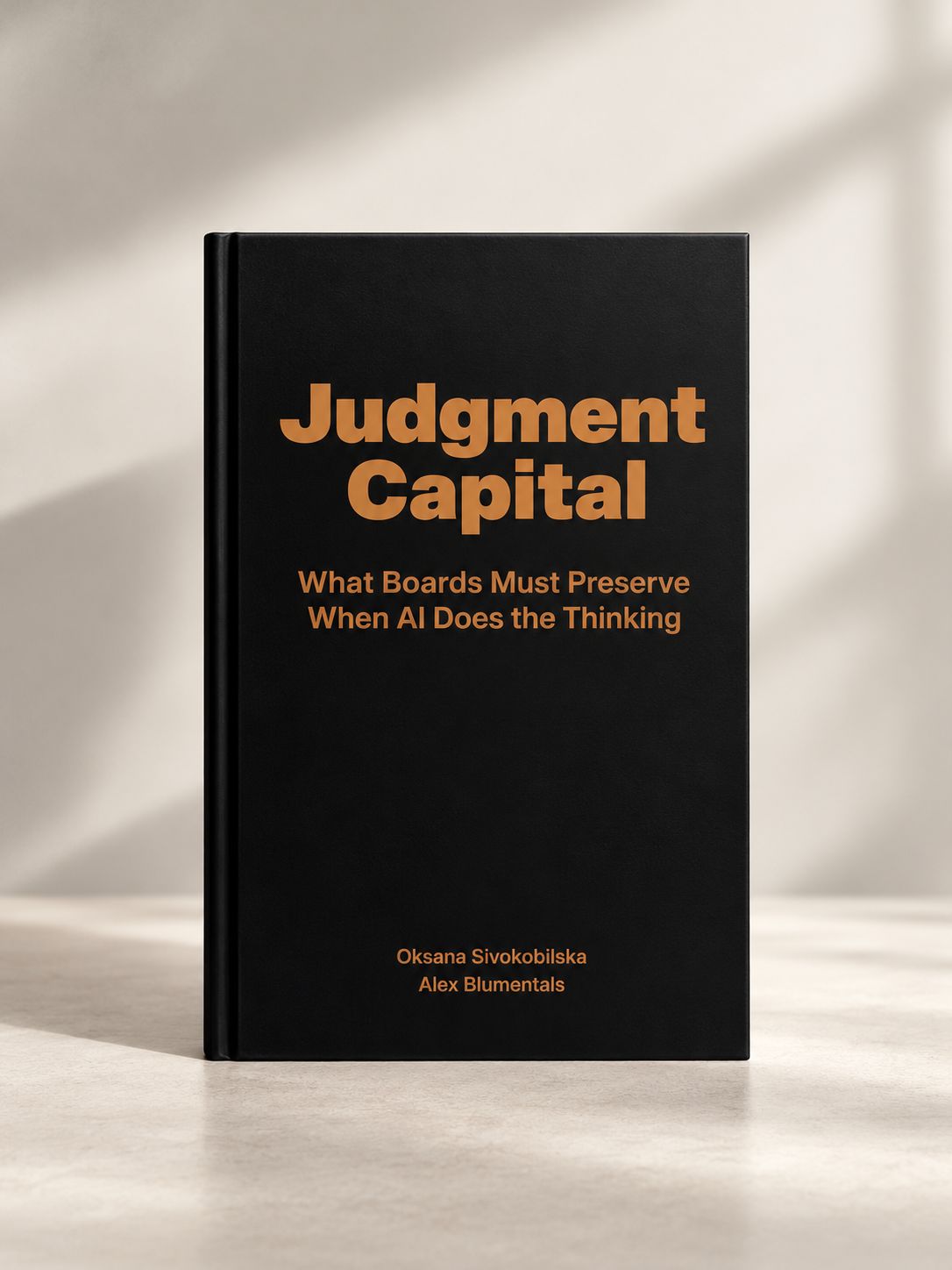
The app is built from Judgment Capital by Alex Blumentals and Oksana Sivokobilska. The method is in the book; the app runs it.

Oksana Sivokobilska and I wrote the argument in full: why judgment is an asset with a balance, how organisations run it down without noticing, and what a board can do about it. TwinLadder is the app that does the running.
Ten questions, scored on evidence. You see your rung, your zeros, and the five questions to take to your next board meeting.
Rather talk first? Send an enquiry.