
TwinLadder

Which rung are you on?

The self-score from chapter 12 of Judgment Capital. Ten questions, each scored on evidence, place your organisation on one of five rungs.

Free, no account needed, and no email to see your result. Best answered by two people: one from risk, one from HR.

The ladder self-scoreNot saved
From Judgment Capital, chapter 12 · your organisation

Ladder score 0 of 20 · 0 of 10 answered

Question 1 of 10 · Aware’s floor

The line and the name

Does the erosion of human judgment have a line on a register that a board committee actually reviewed last quarter, and can you, without looking it up, name the officer who answered for it?

Evidence: the minutes.

Question 2 of 10 · Aware’s floor

The signals on demand

For your three most automated decision processes, can someone produce by tomorrow the current human-override rate and its direction (over eight quarters, or since collection began, with the start date on the record), the shape of the intake curve, and, for the volume the machine decides without any human seeing it, the share that was sampled last quarter?

Evidence: the numbers, not a narrative about them.

Question 3 of 10 · Controlled’s floor

The marked map

Has the owner of each automated workflow marked it, step by step, into the steps that form judgment and the steps that are safe to hand over?

Evidence: a map with marks on it, signed by the person who runs the process.

Question 4 of 10 · Controlled’s floor

The threshold that fired

Has a watched indicator crossed a pre-set threshold at least once, and did the crossing trigger the response agreed in advance, rather than a meeting about whether to respond? A scheduled drill scores full marks; a real crossing is the stronger evidence, not a higher score.

Evidence: one worked example, end to end.

Question 5 of 10 · Controlled’s floor

The mark that survived money

Has a step marked protect come through a budget round in which automating it would have saved money somebody wanted? A protection that has never been tested against a saving is a declaration.

Evidence: the budget decision itself.

Question 6 of 10 · Resilient’s floor

The work without the tool

In the last year, have practitioners done real cases tool-free, with the results scored and kept, so that capacity can be compared over time?

Evidence: this year’s scores, with the prior round’s beside them where one exists. A first round, scored and archived, counts.

Question 7 of 10 · Resilient’s floor

The stage that cannot be skipped

Is there a stage in the junior’s path the tool is not allowed to shorten, and can you name the most recent junior who passed through it?

Evidence: a person, with a date.

Question 8 of 10 · Resilient’s floor

The pair in the calendars

Is a senior currently paired with a junior on live work, in both directions (the junior bringing the senior up the tool curve, the senior transmitting judgment), and are the hours real?

Evidence: the logged hours, both directions, signed by the programme’s owner, not the programme description.

Question 9 of 10 · Antifragile’s floor

The override that taught

Point to one thing (a decision rule, a threshold, a training case) that exists because a human caught the machine being wrong in the last two quarters.

Evidence: the artifact, with its date.

Question 10 of 10 · Antifragile’s floor

The rebuild, tools down

Take one consequential output from last month. Name the person who could reconstruct and defend it with the tools off, and say when that was last actually tried on anything.

Evidence: a name and a test, not a belief.

Recently means within the last two quarters, unless the question says otherwise.

Add up your ten answers out of 20. Your rung is the highest whose questions, and every question below them, score two. Any zero and no rung can be claimed.

Five rungs

Each rung is a state your board can check for itself.
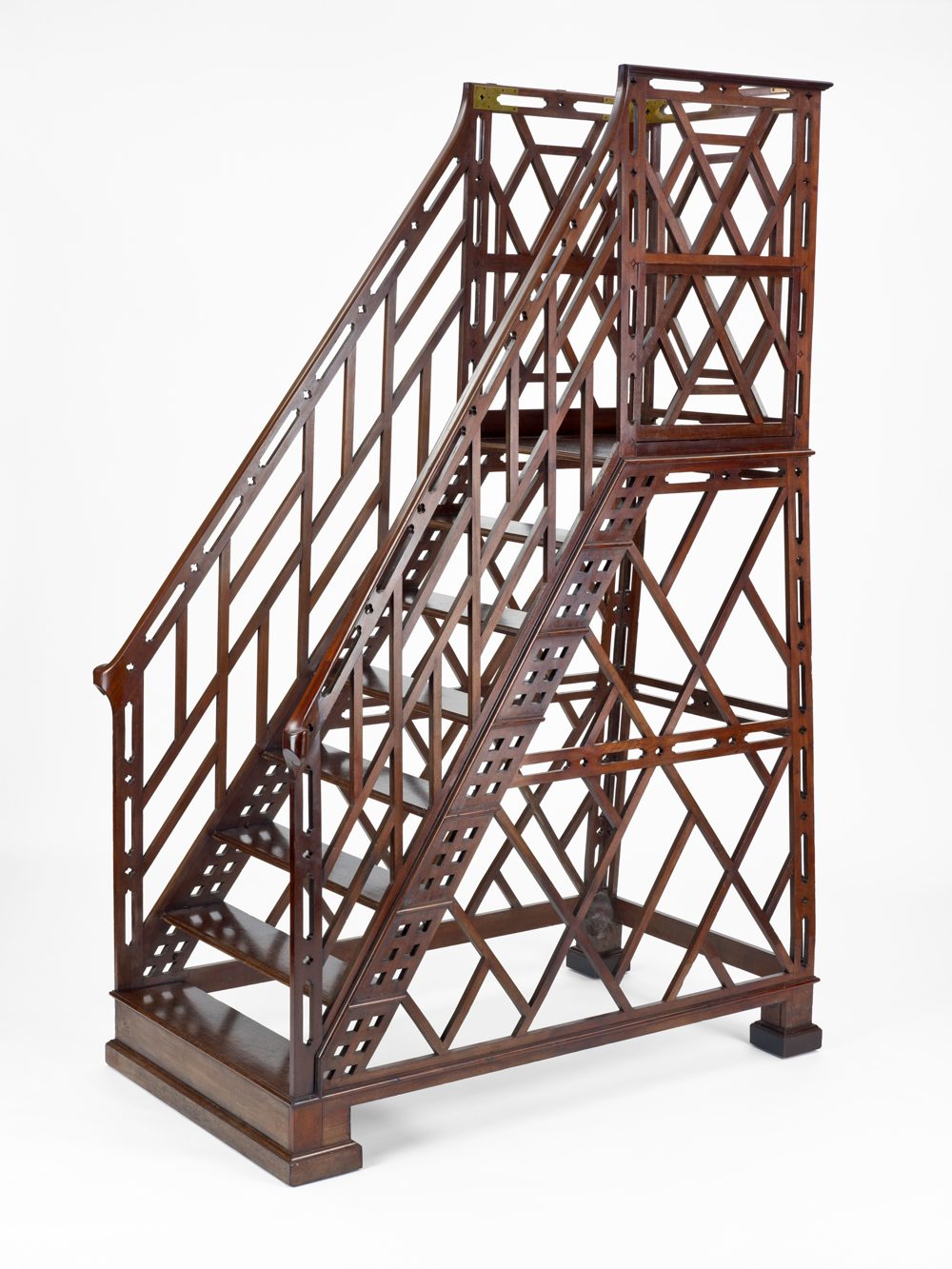
A mahogany library ladder of 1782, its open fretwork sides rising in steps to a railed platform
Library ladder, William France, 1782.
  1. Blind

    The starting state

    Your result

    No line anywhere for what the machine is doing to the people around it. Every instrument reports good news.

  2. Aware

    Floor: questions 1 and 2

    Your result

    The line exists, with a name against it. Override rate, intake and catch ratio are read together, and an officer answers when the board asks.

  3. Controlled

    Floor: questions 3 to 5

    Your result

    Thresholds set in advance have fired at least once. Processes are marked into steps to protect and steps to hand over. The volume no human sees is sampled.

  4. Resilient

    Floor: questions 6 to 8

    Your result

    Formation is designed back in: pairing on live work, a stage the tool may not shorten, real cases done with the tools off and scored.

  5. Antifragile

    Floor: questions 9 and 10

    Your result

    The organisation judges better because the machine is there. Every override is logged and taught. The book draws this rung so the direction has a name.

Ten questions

Zero: the evidence does not exist. One: it exists on paper. Two: it happened recently and would survive an auditor.

A grey-haired woman at a desk by the window, reading a printed document with a pen in hand
Every answer points to a document someone can put on the table.

AwareThe floor for this rung

  1. The line and the name.Evidence: the minutes.
  2. The signals on demand.Evidence: the numbers.

ControlledThe floor for this rung

  1. The marked map.Evidence: a map signed by the person who runs the process.
  2. The threshold that fired.Evidence: one example, end to end.
  3. The mark that survived money.Evidence: the budget decision.

ResilientThe floor for this rung

  1. The work without the tool.Evidence: this year’s tool-free scores.
  2. The stage that cannot be skipped.Evidence: a person, with a date.
  3. The pair in the calendars.Evidence: logged hours, both directions.

AntifragileThe floor for this rung

  1. The override that taught.Evidence: the rule or case it produced, dated.
  2. The rebuild, tools down.Evidence: a name and a test.

What you get

Your rung, every zero named first, and the method that produces the missing evidence.

A one-page result on screen, with no email asked. Leave an email only if you want to save it or get the PDF. For each answer at zero or one, it names the instrument from Appendix A that would produce the evidence. It also gives you the five questions for Monday and the three-line motion from chapter 13, ready for your next board meeting. Leave an email and we remind you to re-score in 13 weeks, with this quarter’s answers beside the next. The score is self-reported, and the page says so.

ResultSample data
Sample organisation · answered from risk and HR · 21 Oct 2026

Blind, with 1 unwatched dimension

Ladder score 11 of 20 · 1 at zero, 7 at one, 2 at two

Zero, first

  • 0
    The rebuild, tools downProduces the evidence: a tools-down rebuild on one consequential output (Appendix A, A.5). Authorship erosion.

At one

  • 1
    The signals on demandProduces the evidence: monthly defect review beside the intake curve (A.2, A.1). Competence drift, pipeline collapse.
  • 1
    The marked mapProduces the evidence: pre-automation value audit and the signed protect / hand-over map (A.7, Appendix B). Serves all six.
  • 1
    The threshold that firedProduces the evidence: seeded known-bad cases against a pass rate set in advance (A.4). Detection blindness.
  • 1
    The mark that survived moneyProduces the evidence: the signed map, carried into the budget round (A.7, Appendix B). Serves all six.
  • 1
    The work without the toolProduces the evidence: tools-down rebuild, scored and kept (A.5). Authorship erosion.
  • 1
    The stage that cannot be skippedProduces the evidence: pairing on live work, with a stage the tool may not shorten (A.1). Pipeline collapse.
  • 1
    The pair in the calendarsProduces the evidence: senior–junior pairing, hours logged both ways (A.1). Pipeline collapse.

Before any rung: bring the rebuild, tools down to one. Then Aware needs question 2 at two.

Self-reported. The self-score locates you; it does not certify you.
Save itOptional

We remind you to re-score in 13 weeks, with these answers beside the next.

For your next board meetingChapter 13

Five questions for Monday

  1. Who overrode the machine?
  2. Who decided what to protect?
  3. Tools down, who catches it?
  4. What did nobody see?
  5. Where is it written?

The motion, three lines

  1. That management answer these five questions in writing within sixty days.
  2. That a named person verify the answers.
  3. That the answers return to this committee as an agenda item.

A score for a quarter

“A ladder read once is a diagnosis… A ladder read quarterly is a different object.”
Judgment Capital, chapter 12

The self-score locates you. Certifying the score needs someone with no stake in the answer to read the evidence. In the app, that is the verifier you name.

A board meeting by tall windows: a grey-haired director speaks while the others at the table listen

Two more free checks

A young man at a desk, reading a printed page closely, pencil in hand

The Power Test

A short exercise for one person: work through cases and see where you would have caught the machine. Your result is yours. It measures nothing about your organisation, and it is not sold as a measurement.

Try the Power Test
Bound volumes of the Official Journal of the European Union on a library shelf

The readiness check

Seven pillars from the Twin Ladder Standard, for the AI Act floor. Free the first time, and included in every plan after that.

See the readiness check

Questions

Two people who can find evidence: one from risk or audit, one from HR. A board member can answer alone, and will learn which answers they could not source.

No. It locates you. A reading becomes evidence when a named person independent of the owners verifies it.

Without an email, nothing is kept. With one, the score is saved so next quarter’s sits beside it, and the history stays free. If you subscribe, each answer links to its evidence in the register.

No. The result shows on screen. An email is only to save it, get the PDF and the reminder.

Each question asks for evidence a board can demand. The book’s authors built them so a fluent answer scores one, and only behaviour scores two.

Judgment Capital, chapter 12, sections IV and V.

Score your organisation

Free, no account needed, and no email to see your result.