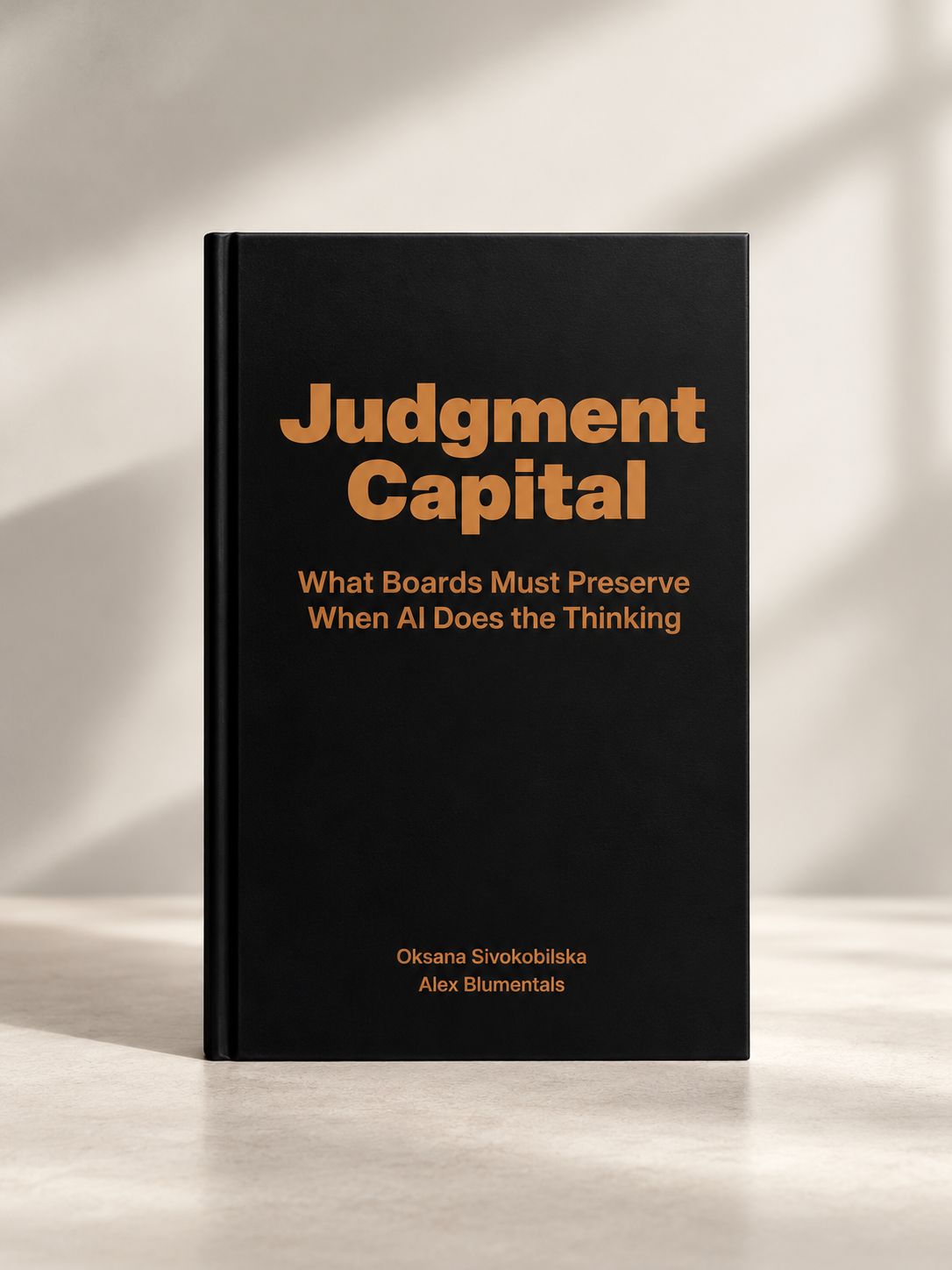
Where does judgment live now? How will it form from here?
“We build the ladder that lets organizations form judgment that lasts.”
Every AI decision your organization makes rests on human judgment — where it lives, how it was formed until now, how it will be formed from here. Real competence means your people can work with AI effectively, verify its outputs, and make sound decisions when the stakes are high. That is what we build.
The competence paradox.
AI does not just automate tasks. It quietly erodes the conditions under which people learn to do those tasks well.

Entry-level work is disappearing
AI handles the routine tasks juniors traditionally learn from. The skills pipeline breaks before anyone notices.

Senior judgment goes unchecked
AI automates tasks requiring experienced judgment. If the next generation never built the expertise, who checks the machine?

The gap widens every quarter
Each round of automation makes the competence gap harder to close. The distance between AI output and human verification grows silently.

“This is not a technology problem. It is a human capital problem that technology created. Solving it requires deliberate competence development — not just better tools.”
Four levels of AI competence.
Four levels that trace how judgment about AI is formed — from first literacy to setting the standard for others. Each level addresses a specific organizational need.
Lead cross-organizational AI initiatives. Set standards for your industry, contribute to regulatory development, and build partnerships that advance responsible AI adoption at scale.
Design and manage AI-augmented processes across teams. Establish governance frameworks, quality assurance protocols, and training programs that make AI competence systematic rather than individual.
Apply AI within your specific professional domain. Build verification workflows, develop judgment about when to trust AI outputs, and integrate tools into daily practice with documented methodology.
Understand what AI systems do, what they cannot do, and how to interact with them responsibly. Article 4 asks organizations to support this — a best-efforts duty, discharged by showing your measures. This level is that evidence.

“We are not technologists talking down to professionals. We understand what it means to face a new tool and wonder: Can I trust this output? What happens when it is wrong? Where does my liability begin? Every product we build starts from the practitioner's perspective — because AI competence must serve the work, not the other way around.”
Co-founder & CTO
Training, assessment, and ongoing support.
Not a one-off workshop. A continuous competence platform that evolves with the technology and regulation it covers.
AI is an enabler, not a replacement.
AI does not replace professionals. It changes what they need to know. The organizations that invest in competence today are not eliminating roles — they are ensuring their people can handle growing complexity without sacrificing quality or burning out. The competence paradox only hurts organizations that ignore it.
The question is not whether to adopt AI. It is how your people's judgment will be formed once you do.
A regional network, anchored in assessment science
Twin Ladder is building regional chapters so our assessment methodology lives in local data and local context. Each chapter is led by a regional scientist or lead.
Europe
Latvia & EU
Southeast Asia
Jakarta, Indonesia
Americas
Africa
Read where your judgment stands
Take our free assessment for a first reading of where your organization's judgment stands, subscribe to weekly intelligence, or explore our training programs.
Built for practitioners. — Cross-functional by design — legal, finance, HR, operations