 TwinLadder
Six ways judgment wears down
The failure modes from Judgment Capital, each with an owner, a reading for the board and a working method from Appendix A.
| Mode | Owner | Reading this quarter | Threshold | Tier |
|---|---|---|---|---|
| Pipeline collapse | CHRO | Junior intake 4, down from 9 | Floor 6 | Concern |
| Competence drift | CRO | Override rate 2.1%; blind re-judgment agrees 91% | Re-judge 1 in 8 | Watch |
| Inquiry groupthink | CRO | Divergence method run on 3 of 5 board decisions | Every consequential decision | Watch |
| Detection blindness | CRO · CHRO | Claims desk caught 31 of 40 planted cases (78%) | 85%, set by the board | Concern |
| Authorship erosion | CRO | Tools-down rebuild: 6 of 10 completed unaided | Yearly, last Nov 2026 | Watch |
| Agency erosion | CRO | 0 overrides exercised; halt points named in 2 of 7 flows | A tested halt point in every flow | Watch |
“A register needs a fixed vocabulary of failure modes, or every owner will describe the same decay in different words and nothing will aggregate. There are six.”
Two lines, two owners
Pipeline collapse sits on the succession line, owned by the CHRO. Competence drift, inquiry groupthink, authorship erosion and agency erosion sit on the decision-quality line, owned by the CRO. Detection blindness sits on both: it wears down the bench being formed and the review running today.
Succession line
CHRODecision-quality line
CROEach mode below follows the same order: what it looks like, who owns it, what the app reads, the method that holds it, the workshop that installs it.
Pipeline collapse
The juniors who would become your seniors are no longer hired, or no longer formed.
The work that used to train them is automated, so the climb closes. A specialist leaves and no one has been formed behind her.
“A programme is a declaration. A calendar is behaviour.”
- Owner
- CHRO.
- The app reads
- Intake against a minimum junior share; coverage of the protected practice steps; time to reach competence without the tools; successor coverage for key judgment.
- Method
- Senior–junior pairing on live work, logged in both directions, with a floor of hours per junior per quarter (Appendix A, A.1).
- In the book
- Chapter 10 names it; chapter 11 sets the condition for bringing it down; chapter 14 on intake and pairing; Appendix A, A.1.
- Workshop
- W5 Pairing That Runs Both Ways

- Junior intake
- 4 this year, down from 9 · floor 6
- Protected steps covered
- 9 of 12
- Pairing at the floor
- 11 of 14 juniors this quarter
- Successor coverage
- 7 of 11 key-judgment roles
- Tier
- Concern
Competence drift
The people in the role slowly settle into agreement with the machine.
Overrides fall, and nobody can say whether the machine got better or the reviewers stopped looking. The override rate alone cannot tell you.
- Owner
- CRO.
- The app reads
- The override rate beside a blind re-judgment floor: for example, one decision in eight re-judged without seeing the machine’s answer.
- Method
- A monthly defect review, ten failures read by eye against outcomes (Appendix A, A.2), and the blind re-judgment floor (chapter 11).
- In the book
- Chapter 10 names it; chapter 11 sets the blind re-judgment floor; Appendix A, A.2.
- Workshop
- W6 Overrides That Count

- Override rate
- 2.1%, down from 3.4% a year ago
- Blind re-judgment
- 1 in 8 · 212 this quarter · agrees 91%
- A.2 defect review
- 10 failures read in January · next 3 Feb
- Tier
- Watch
Inquiry groupthink
Every seat in the room draws on the same fluent source, and the room stops producing alternatives.
The gain is real: every director can be briefed to the same depth. The risk is that unanimity now certifies one account reflected in every chair. This is a risk for the board, the investment committee and the strategy room.
- Owner
- CRO.
- The app reads
- The share of consequential decisions where a divergence method was run before the recommendation was seen; how often dissent was recorded.
- Method
- A divergence method and a decision registry (Appendix A, A.3).
- In the book
- Chapter 10 names it; chapter 11 sets the condition for bringing it down; Appendix A, A.3.
- Workshop
- W7 The Divergence Round

- Consequential decisions
- 5 this quarter
- Divergence run first
- 3 of 5, before the recommendation was seen
- Dissent recorded
- 2 of 5
- Next registry entry
- Investment committee, 11 Feb
- Tier
- Watch
Detection blindness
The people who review the machine’s work lose the ability to catch what it missed.
It usually shows up as the loss itself: the error nobody caught, arriving as a bill. So it is tested on purpose. A small cell outside the desk plants known-bad cases from your own history into the live queue. Nobody on the desk knows which.
“A monthly handful reads the desk, not the person.”
- Owners
- CRO presents it; CHRO owns the formation half.
- The app reads
- Caught out of planted, the miss rate and the time to catch, by desk, against a pass rate the board sets in advance.
- Method
- Seeded known-bad cases (Appendix A, A.4).
- In the book
- Chapter 10 names it; chapter 11 has the board set the pass rate in advance; Appendix A, A.4.
- Workshop
- W3 Fire Drills for Judgment

- Caught of planted
- 31 of 40 (78%)
- Miss rate
- 22%
- Time to catch
- Median 2.4 days
- Pass rate
- 85%, set by the board 12 Sep 2026
- Tier
- Concern since 14 Jan 2027
Authorship erosion
The work reads well, and nobody in the building could rebuild it with the tools off.
The reasoning has moved out of the people and into the machine. A fluent output hides it until someone tries.
- Owner
- CRO.
- The app reads
- The unaided completion rate on a defined task set, tools off, supervised, at least once a year.
- Method
- The tools-down rebuild, measured (Appendix A, A.5). The book is plain about its limit:
run it to detect, not to cure.
- In the book
- Chapter 10 names it; chapter 11 sets the condition for bringing it down; Appendix A, A.5.
- Workshop
- W3 Fire Drills for Judgment

- Task set
- 10 defined tasks, tools off
- Completed unaided
- 6 of 10
- Last run
- Nov 2026, supervised
- Next run
- Nov 2027
- Tier
- Watch
Agency erosion
Someone sees the machine is wrong, and the process gives them no way to make it count.
It fails two ways. The person overrides and is punished for it. Or the process admits no human input at all, and the machine’s output is the decision.
“Zero is not good news and not bad news; it is an unanswered question.”
“One punished override destroys the channel.”
- Owner
- CRO.
- The app reads
- Overrides exercised per quarter, and the share of automated flows with a named, tested halt point.
- Method
- A sanctioned override channel and drilled halt points (Appendix A, A.6).
- In the book
- Chapter 10 names it; chapter 11 sets the condition for bringing it down; Appendix A, A.6.
- Workshop
- W6 Overrides That Count

- Overrides exercised
- 0 in Q4 2026
- Named, tested halt point
- 2 of 7 automated flows
- Next halt-point drill
- 9 Mar 2027
- Tier
- Watch
Before you automate
One check serves all six: a one-page audit of each step before the automation case is approved.
The process owner and a delegate of the CHRO walk each step as it is actually worked. What does this step teach, and what will the changed role need that nobody has done before? The answer is one page per step. Each process owner then signs a map: the steps to protect, and the steps safe to hand over.
- The app reads
- The share of automation cases above your threshold that passed the audit before approval.
- Method
- The pre-automation value audit (Appendix A, A.7) and the process owner’s decision (Appendix B).
- In the book
- Chapter 10 on what to protect; Appendix A, A.7; Appendix B, the register on one page.
- Workshop
- W4 Mark the Work
- Read the first notice of lossTeaches what a normal claim looks likeProtect
- Check the policy is in forceTeaches nothing the role still needsHand over
- First-pass fraud checkTeaches the patterns the drills testProtect
- Request missing documentsTeaches nothing the role still needsHand over
- Set the first reserveTeaches the judgment a senior is promoted forProtect

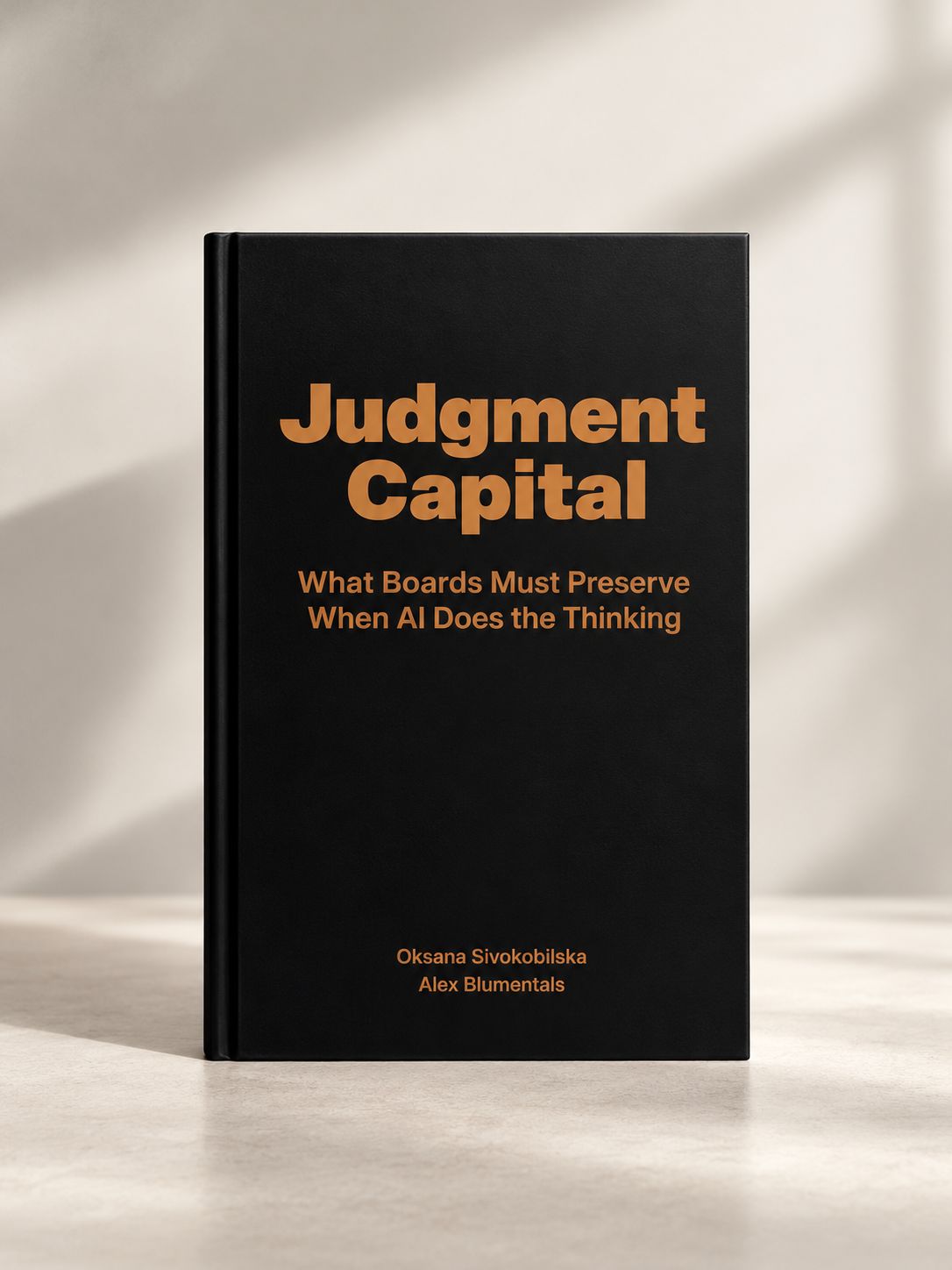
Read them in the book
Chapter 10 names the six. Chapter 11 sets the conditions for bringing each back down. Appendix A gives the working method for each, with its sources and how well grounded it is. Appendix B puts the register on one page.
- Chapter 10, The Register. Two lines, three tiers, six modes.The register
- Chapter 11, Running the Register. Thresholds, the conditions for coming back down, the decisions no human saw.Thresholds and drills
- Chapter 12, The Ladder. Five rungs, ten questions, the zero rule.The quarterly score
- Chapter 13, The Agenda Item. Five questions for Monday, the motion, the verifier.The board reading
- Appendix A, The Working Methods. Seven methods, one per mode and one before you automate.What the app schedules and logs
- Appendix B, The Register on One Page. The entry, and each process owner’s protect or hand-over decision.Entries and the map
Score your organisation
Ten questions, scored on evidence. You see your rung, your zeros, and the five questions to take to your next board meeting.
Rather talk first? Send an enquiry.