

The signature on the cornerstone
There is a small detail in the new encyclical that most coverage has missed, and it carries more weight than the headline.
On 15 May 2026, Pope Leo XIV released Magnifica Humanitas, his first encyclical, addressed to the question of what artificial intelligence is doing to the human person. He did not pick the date at random. It is the 135th anniversary of Rerum Novarum, the document Leo XIII published in 1891 about steam, the textile factory, and the working man's wage. The new pope chose the name Leo for the same reason. He is signing his pontificate into a single, continuous tradition of judgements that the Catholic Church has been making about industrial transformation since the railway era, and he is telling us, by the date on the cornerstone, that he believes this transformation belongs in that tradition.
You do not need to be Catholic to find this useful. Few institutions on the planet have continuously stated positions on automation, work and human capability across the full 135-year span from steam to silicon. Reading the encyclicals in sequence, against the technologies they respond to, you get something that is closer to a long-run dataset than to homily. And the dataset has a property worth noticing.
The Church never predicts. She waits.
A short history of late verdicts
Lay the social encyclicals against the technological calendar and the lag is the first thing you see.
Rerum Novarum (1891) was published fifty years into the First Industrial Revolution. The British factory acts had been on the statute book since the 1830s. Quadragesimo Anno (1931) came two years after the 1929 crash and twenty years after the Highland Park assembly line. Laborem Exercens (1981) was issued when industrial robots had been shipping in Japanese auto plants for nearly a decade — and four weeks after the IBM PC went on sale. Centesimus Annus (1991) came down two years after the Berlin Wall and six months after the public Web. Laudato Si' (2015) followed the platform economy into full maturity; Fratelli Tutti (2020) appeared two months after GPT-3 was released.
And now Magnifica Humanitas, three and a half years after ChatGPT entered general use, with the EU AI Act already in force and AI capital expenditure running at roughly 1.2 per cent of US GDP — a build-out larger in scale than the telecoms boom of the 1990s and approaching, in some accountings, the railway era.
The pattern is consistent across thirteen decades. The Church does not arrive early. She arrives once the technology has produced its first real victims, looks at what it has done, and issues a judgement on a body of evidence.
This is the opposite of the posture taken by the firms producing the technology, which is to predict, to set the future, to act now and apologise later if the apology becomes commercially necessary. The Pope's method is slower. It also has a 135-year track record of getting the diagnosis approximately right, which is more than the predictive futurists can claim.
The implication for how to read Magnifica Humanitas is direct. It is not an early warning. It is a verdict. The Pope is telling us — citing the data labellers paid below subsistence in the Global South, the cobalt mines, the trafficked young women routed through digital infrastructure, the children whose attention is monetised away, the workers whose pace is set by an algorithm they cannot see — that the visible harms are now sufficient to issue judgement. He is naming this technology, as currently deployed, as a structural problem on the same order of seriousness as the nineteenth-century factory.
That is a strong claim. It deserves to be read with the seriousness any verdict from a 135-year institution warrants, including by readers who do not share the institution's theology.
Babel and Nehemiah
The encyclical's introduction is built around two scenes from scripture, and once you see them you cannot unsee them. They are the rhetorical hinge of the entire document.
The first is Babel: the people on the plain at Shinar who set out to build a tower with its top in the heavens, fearing dispersion, seeking to "make a name" for themselves. A single language. A single technology. A single direction. Leo XIV reads it as a parable of self-sufficiency — a grand façade without the formation beneath, a project that confuses uniformity with unity, a city that ends in dispersion because nothing inside it was holding people together.
The second is Nehemiah, who returns to a ruined Jerusalem after the exile and rebuilds the walls. Before he rebuilds, he listens. He walks the rubble in silence. He convenes the families and gives each of them a section of the wall to put back up. The text is patient about who does what. Men, women, priests, artisans, heads of households, young people: each rebuilds in front of the house they will live in. The wall is rebuilt because the people are rebuilt first. The order matters.
"We must, then, avoid the 'Babel syndrome' — namely the idolatry of profit that sacrifices the weak, a uniformity that neutralizes differences, and the pretense that a single language, even a digital one, can translate everything, including the mystery of the person, into data and performance."
This is the figure he hands the rest of the document. Every AI deployment, every governance regime, every regulatory framework, can be read against the same question: is this project of the Babel kind, or the Nehemiah kind? Is it a grand façade with no formation beneath, or is it a slow rebuild section by section, with the families who will live behind it?
Hold that figure in mind. The EU AI Act, on a particular day, in a particular boardroom, becomes one or the other depending on how the people in the room decide to read it.
Four constants in the formation of a person
Read the encyclicals in chronological sequence and the technology rotates while one thing stays still. The anthropology does not move.
The human being is held to be:
- carrying a dignity that exists prior to and independent of economic output;
- formed and matured through work, where work is understood not only as subsistence but as constitutive of the person;
- genuinely free, in a sense strong enough that bad design choices can deform a person and good ones can form one;
- ordered toward a common good that is something more than the sum of individual goods.
These four claims are repeated by every pope across the 135-year arc, from Leo XIII through Pius XI, John XXIII, Paul VI, John Paul II, Benedict, Francis, and now Leo XIV. The doctrine is older than any technology any of them was responding to. It is the constant under the rotation, and it is the reason the institution can make stable judgements across very different industrial conditions.
There is a secular version of the same move. Strip the theology and you are left with a small number of mechanisms that have been confirmed empirically and that the cognitive-science literature treats as stable:
- Human judgement is formed through practice.
- Practice is formed through reps.
- Reps require apprenticeship.
- Apprenticeship requires institutional design choices that protect the formation pathway.
Twin Ladder makes the second list rather than the first. The encyclical makes the first. Both are saying that the form of the technology does not determine the fate of the worker. The design choices do, and the design choices are governed by what we believe a human person is for.
The 1981 encyclical insisted that work is not a commodity.
The 2026 encyclical insists that intelligence is not a function.
That single line, more than any other in the document, is the pivot. Forty-five years ago, Laborem Exercens refused the equivalence between labour as a constitutive human act and labour as production-input on a balance sheet. Magnifica Humanitas refuses the parallel equivalence between human intelligence and what current AI systems do. The Pope is careful in his treatment: these systems imitate certain functions of intelligence; they do not undergo experiences, do not possess a body, do not feel joy or pain, do not mature through relationships, do not know what love or work or friendship or responsibility mean from the inside. They have no moral conscience. The category collapse that the dominant marketing narrative is trying to enforce — intelligent assistant, AI colleague, the system thinks, the system decides — is, on this reading, the same category collapse the encyclical refused in 1981 in a different idiom.
The friction the encyclical calls rest
The most useful passage in Magnifica Humanitas for anyone working on AI governance is not in the chapters that grade the technology. It is in the chapters that prescribe what professionals and institutions ought to be doing with their time.
The encyclical calls, repeatedly, for rest, silence, patience, in-depth study, judicious analysis, the cultivation of relationships in physical presence, time spent with the lonely, the long journey of education that bears fruit only over time. To a reader unfamiliar with the tradition, those passages can sound like religious overlay on what is otherwise a policy document. They are not. They are a precise diagnosis of a mechanism that the secular learning-science literature has been describing for four decades under a different name.
The cognitive-science name for what the encyclical calls rest and silence and patience is friction.
The claim, in plain language: human capability is not formed in frictionless interaction with a tool. It is formed in resistance — friction with the problem, friction with one's own incomplete understanding, friction with the evidence, friction with colleagues who disagree, friction with the gap between what one thought one knew and what the case is actually demanding. Polanyi's work on tacit knowledge points at this. Sennett's The Craftsman points at this. Ericsson's deliberate-practice literature points at this. Lisbeth Bainbridge's 1983 paper on the ironies of automation pointed at this in an industrial-safety register, and the 2025 Lancet study on colonoscopy deskilling pointed at the same mechanism in a clinical RCT.
Take the friction out, and the formation does not transfer to the machine.
It stops happening in the human.
Plato got there first. The encyclical quotes him, almost obliquely: the deepest things are learned "by engaging in discussion with others, striking upon ideas and experiences together like flint until the spark of understanding is kindled within us." That sentence is a description of an apprenticeship in any profession that has one. It is also a description of what the colonoscopy study measured: a clinician handed AI-pre-flagged lesions for long enough loses the unaided detection rate. The lesion the AI catches is the rep the clinician never has. The friction was the formation pathway. Remove it, and the pathway closes.
The rep that builds the judgement migrates to the machine.
The human loses the formation pathway.
And the loss is invisible, because it is the experience that never happens.
The encyclical's bluntest sentence on this, quoting an earlier Vatican note from January 2025:
"While AI promises to boost productivity by taking over mundane tasks, it frequently forces workers to adapt to the speed and demands of machines, rather than machines being designed to support those who work. As a result, contrary to the advertised benefits of AI, current approaches to technology can paradoxically de-skill workers, subject them to automated surveillance and relegate them to rigid and repetitive tasks."
A magisterial document using the word de-skill is unusual. It is also exactly the mechanism the cognitive-risk literature has been labelling for years. When a clinical trial, a 135-year religious tradition, an industrial-safety classic from 1983, and a recent paper on the Turing trap all flag the same risk through different vocabularies, the risk is real. The encyclical's contribution is to add one more witness — perhaps the most institutionally durable one available — to a diagnosis that secular communities were already arriving at by independent routes.
What the internet already taught us about commons
There is one passage in the encyclical worth pulling out separately, because it points at a question almost no one in the current AI debate is willing to ask out loud. Leo XIV writes that ownership of data "cannot be left solely in private hands," that data is "the product of many contributors and should not be treated as something to be sold off or entrusted to a select few," and that we have to "think creatively in order to manage data as a common or shared good." The sentence is short. The implication is not.
The precedent already exists, and it is not religious. It is the internet. We built it together over several decades, it supports almost everybody with a phone, and no one owns it as a piece of property. The protocols are public — TCP/IP, HTTP, DNS — and they sit underneath everything else. The wires and the data centres are private; companies compete to run them better and cheaper. The applications on top are competitive, ferociously so. The shared layer is the precondition for the competitive layer. Without the open protocols there is no market on top — only whoever owns the cable charging rent to whoever wants to send a packet through it.
AI is being built the other way around. The most consequential capture in the current architecture is at the compute layer. Three or four hyperscalers run the data centres on which every serious frontier model depends. Anthropic, OpenAI, Mistral and the other frontier laboratories do not compete with one another on raw compute. They compete on model training, on safety positioning, on the quality of their post-training, on customer relationships. Their compute is infrastructure they all use and that none of them owns. And yet the architecture of the sector treats that infrastructure as a private good rented to them by a small number of firms whose own strategic interests do not align with the laboratories that depend on them.
The hundreds of billions in hyperscaler capital expenditure now being committed is presented as the only way this technology can be deployed at scale. It is not. The compute layer is a candidate for commons constitution in the same sense that TCP/IP, the railway gauge, and the regulated long-distance lines of mid-twentieth-century telecoms were commons constitutions: shared infrastructure on top of which actors who genuinely do compete with each other can build their differentiated products. AT&T-Bell Labs in the regulated-monopoly era ran a compute-and-communications substrate for the entire telecoms stack; the differentiated products on top of it were built by other firms. The late-1990s telecoms build-out laid dark fibre that ruined its original financiers but became the substrate on which the next two decades of the consumer internet were built. The current build-out is laying a substrate of roughly the same scale. The institutional question is who ends up owning it and on what terms.
This is what the Pope is implicitly calling for, even if he does not say it in those terms. The current dependence of the frontier laboratories on three or four hyperscalers is doing the work of hiding the fact that an alternative architecture exists — one in which compute is a commons, model labs differentiate on what they actually differentiate on, and the savings flow back to the public interest rather than to the rent on the substrate. Our own team is preparing the analysis of that alternative — the Third Architecture work — and on present numbers it would cost roughly an order of magnitude less than the current arrangement while producing a better outcome for everyone except the firms collecting the rent. The internet is the proof that the move is possible. The question is whether we choose to repeat it, or accept the enclosure of a layer that does not need to be enclosed.
The floor, and the rung above it
The EU AI Act asks for roughly the same things the encyclical asks for. Transparency. Accountability. Human oversight of high-risk systems. Continuous training. Protection of the vulnerable. Article 4, the literacy clause, requires that every organisation deploying AI ensure that the people who deploy and operate it understand what it is and what it does.
A regulation is only what its implementation makes of it. Apply the Babel-and-Nehemiah lens to the Act for a moment.
The Babel implementation is recognisable. Register the high-risk system. Paste in the literacy training video. File the conformity assessment. Move on. Compliance is achieved. Nothing in the institution has actually changed. The wall is taller. No one has been formed by the building of it. The encyclical's word for this — where it warns against a more moral AI being defined by a few while the rest of the world checks a box — is Babel.
The Nehemiah implementation looks different. It walks the rubble first. It assesses what the organisation actually does and where its judgement is actually being formed, and where the AI has begun quietly to take over the rep that used to build the formation.
It designs training that builds the unaided judgement, not only the prompted one.
It treats the apprenticeship pathway as something to be protected from being optimised away.
It rebuilds in front of the houses the families will live in.
There is no machinery in the Act itself that determines which of the two readings prevails. That choice lives one rung above the floor. The floor is the regulation. The rung above is the institutional capability to make the regulation do real work — to rebuild rather than to decorate.
This is where the encyclical and the Act are saying the same thing in different idioms. The Pope is not endorsing any standard, and his job is not to. His job is to set criteria. The job of those of us building governance instruments is to meet them — to produce assessments, training and certification that operate in the Nehemiah register, that surface the gap between what the institution thinks it knows and what it can actually do without the tool, and that protect the formation pathway when the next quarter's productivity dashboard is asking everyone to close it down.
What the encyclical contributes to that work, in the end, is twofold. It gives us a vocabulary — Babel against Nehemiah — for distinguishing between governance that decorates a façade and governance that rebuilds capability. And it gives us a 135-year track record of an institution insisting on that distinction even when it was inconvenient, even when the dominant narrative was running in the opposite direction.
That track record is the company worth keeping.
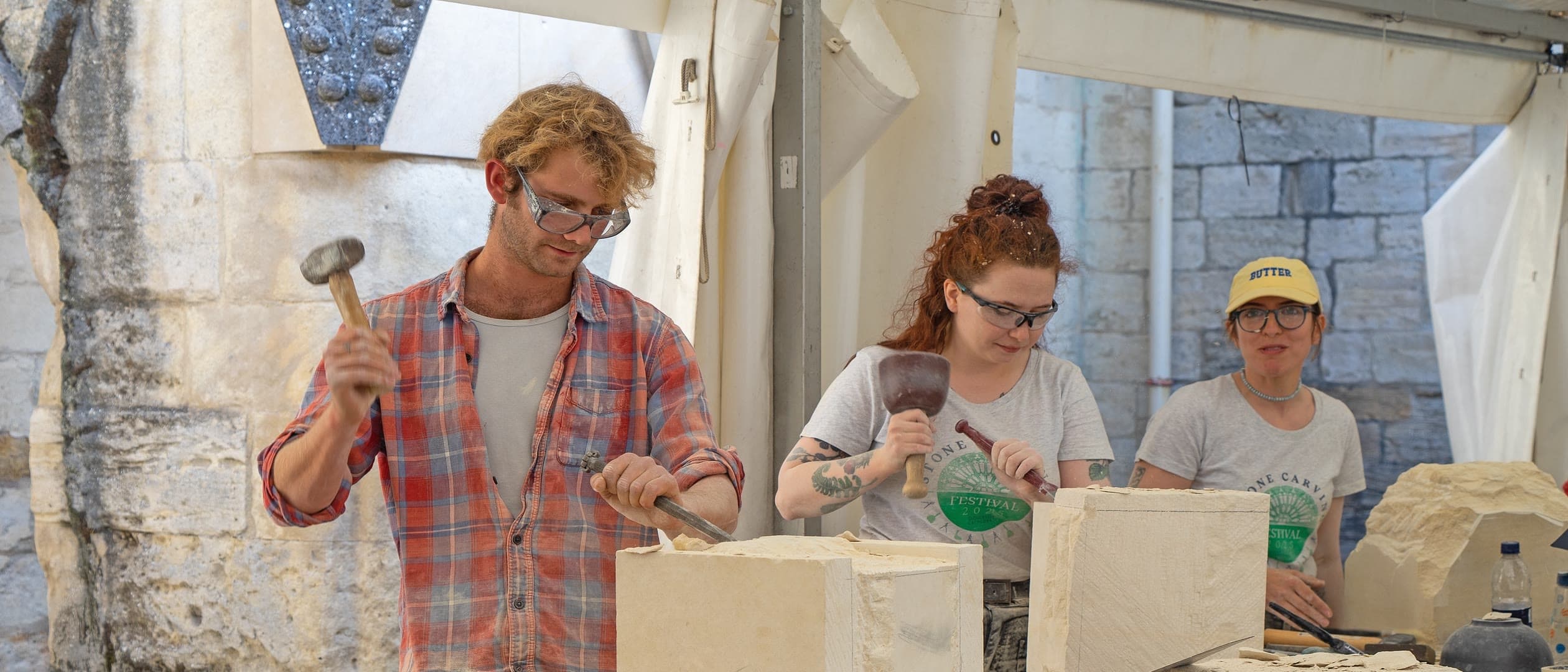
Image: apprentice stonemasons at work, contemporary documentary photography.